

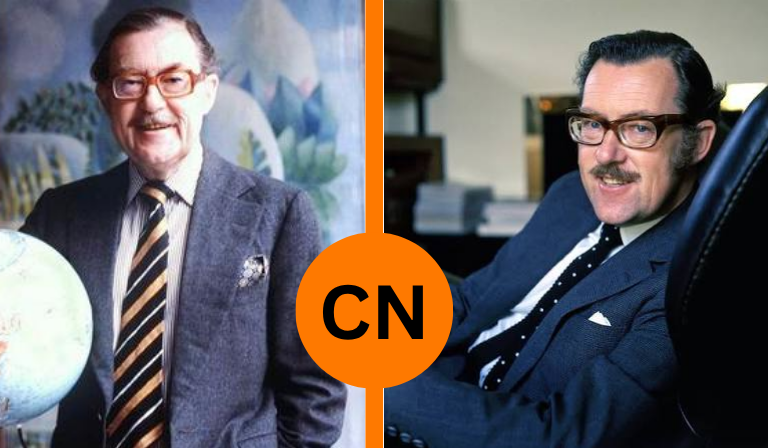
Alan Whicker was one of the most distinctive and influential figures in British television journalism. With his immaculate suits, unmistakable voice, sharp questions, and fascination with people from every corner of the world, he became a household name long before international travel documentaries became common. His best-known programme, Whicker’s World, ran for decades and introduced millions of viewers to cultures, communities, lifestyles, and personalities they might never otherwise have encountered.
Yet his fame was not built on travel alone. His career included wartime service, frontline reporting during the Korean War, current-affairs journalism, and pioneering television work. What really made him special was his ability to combine serious reporting with warmth, wit, curiosity, and entertainment. This article explores the life, career, achievements, personal life, and lasting legacy of one of Britain’s most memorable broadcasters.
Quick Facts About Alan Whicker
| Fact | Details |
|---|---|
| Full Name | Alan Donald Whicker |
| Born | 2 August 1921 |
| Birthplace | Cairo, Egypt |
| Nationality | British |
| Profession | Journalist, broadcaster, television presenter, documentary maker |
| Best Known For | Whicker’s World |
| Major Broadcasters | BBC and ITV |
| Military Service | British Army Film and Photo Unit |
| War Reporting | Korean War |
| Partner | Valerie Kleeman |
| Died | 12 July 2013 |
| Age at Death | 91 |
| Cause of Death | Bronchopneumonia |
| Known For | International documentaries and distinctive interviewing style |
Early Life and Background
Alan Whicker was born on 2 August 1921 in Cairo, Egypt, to British parents. His early childhood changed after the death of his father, and he was brought to England as a young boy. Growing up in Britain, he developed an early interest in writing and journalism.
He later attended Haberdashers’ Aske’s Boys’ School, where his interest in a career involving words and reporting continued to grow. Like many journalists of his generation, his professional ambitions were shaped by a period of enormous political and social change.
Whicker began his working life in journalism, initially gaining experience as a junior newspaper reporter. Those early years helped him develop the essential skills of observation, interviewing, research, and storytelling that would eventually define his television career.
His later success may have looked effortless on screen, but it was built on years of learning how to find a story and communicate it effectively.
Alan Whicker’s Age and Physical Features
Born in 1921, Whicker lived for 91 years, dying in July 2013. During that long life, his appearance became almost as recognizable as his journalism.
He was particularly associated with tailored suits, a mustache, thick-rimmed glasses, and a carefully controlled speaking style. His slightly nasal, highly distinctive voice made him immediately recognizable to British audiences.
Unlike many modern television personalities who rely on highly dramatic presentation, Whicker cultivated a polished and composed image. His clothing and manner gave him an air of confidence and sophistication, while his wit prevented him from appearing overly formal.
These visual and vocal characteristics eventually became part of his public identity and even inspired comedy parodies.
Military Service During World War II
The Second World War was an important chapter in Whicker’s development as a journalist. He served with the British Army’s Film and Photo Unit, working in North Africa and Italy.
The role was particularly relevant to the career he would later build because it involved visual communication. Whicker gained experience in observing events, documenting people, and presenting information through images—skills that became increasingly valuable as television journalism expanded.
One of the remarkable episodes associated with his wartime service came in 1945, when Captain Whicker personally took the surrender of John Amery, a notorious British fascist and Nazi collaborator. Amery was subsequently tried and executed for treason.
The experience of war also exposed Whicker to danger, politics, human conflict, and the unpredictability of real-life events. These experiences would later contribute to the confident and resilient approach he brought to international reporting.
Career and Major Achievements
After World War II, Whicker continued working in international journalism. His career took him beyond Britain and eventually into some of the most dangerous reporting environments of the post-war period.
One of his major assignments came during the Korean War, when he worked as a war correspondent. Reporting from a conflict zone required courage and adaptability, and Whicker experienced the hazards of frontline journalism directly.
At one stage, he was mistakenly reported as having been killed. In response, he sent a famously concise cable to his home office: “Unkilled, Uninjured, Onpressing.”
The incident reflected the dry humor that became a major part of his personality. Even when dealing with serious situations, Whicker had a talent for turning an event into a memorable story without losing its significance.
His next major breakthrough came in 1957, when he joined the BBC’s current-affairs programme Tonight. This role gave him a much larger audience and allowed him to develop the distinctive style that would make him famous.
The Success of Whicker’s World
The defining achievement of Whicker’s career was undoubtedly Whicker’s World, which began in 1965.
The programme was different from many traditional current-affairs shows. It was international, personal, humorous, and highly focused on the characters Whicker encountered. He travelled extensively, meeting wealthy individuals, social outsiders, celebrities, political figures, and ordinary people with extraordinary stories.
The show became a platform for exploring how people lived and what motivated them. Rather than simply reporting facts, Whicker tried to understand personalities and social environments.
His interviewing technique was particularly effective. He could ask deeply personal or uncomfortable questions while remaining remarkably calm and polite. This contrast often encouraged people to reveal more than they initially intended.
Over the years, Whicker’s World moved between the BBC and ITV, remaining popular across changing generations of television viewers.
Why Was Alan Whicker Such a Famous Broadcaster?
The simplest answer is that Whicker understood people.
He knew that a documentary was not only about a location or a subject. It was also about personalities, relationships, contradictions, ambitions, and unusual human behavior.
His questions could be direct, but his delivery was rarely aggressive. This allowed him to enter conversations that might otherwise have become defensive or uncomfortable.
He also possessed an exceptional sense of timing. He knew when to press a subject, when to step back, and when humor could make a serious conversation more revealing.
That combination of curiosity and control made his work accessible to a broad audience. Viewers could learn about unfamiliar places without feeling as though they were watching a formal lecture.
Alan Whicker’s Unique Interviewing Style
One of the most important reasons for Whicker’s popularity was his approach to interviews.
He was capable of asking questions that were remarkably intrusive, yet he rarely appeared hostile. His calm manner often made people underestimate how closely he was examining their answers.
Instead of trying to dominate an interview, he frequently allowed the conversation to develop naturally. He listened carefully and used seemingly simple questions to uncover more complicated stories.
This style became a model for human-interest broadcasting. Whicker demonstrated that serious journalism could be intelligent and probing while still being entertaining.
His voice also added to the effect. The measured rhythm and unusual tone of his speech created an authoritative but approachable presence that audiences quickly associated with international television journalism.
His Influence on Travel Television
Before international travel television became a major genre, audiences often had limited opportunities to see how people lived in distant countries.
Whicker helped change that.
His documentaries did not simply show tourist attractions. He focused on the people behind the destinations. He explored wealth, class, customs, social behavior, cultural differences, and the curious ways individuals organized their lives.
This approach influenced the development of modern travel and documentary programmes.
Presenters who later became associated with international television travel worked in a broadcasting world that had already been shaped by pioneers like Whicker. His willingness to travel widely and interact directly with people demonstrated the power of combining journalism and exploration.
Cultural Impact and Popularity
Whicker eventually became more than a journalist. He became a recognizable part of British popular culture.
His appearance, voice, vocabulary, and jet-setting image were so familiar that comedians could parody them instantly. One of the best-known examples came from Monty Python’s Flying Circus, which famously spoofed him in a sketch involving “Whicker Island.”
The sketch exaggerated the image of Whicker as a sophisticated international interviewer surrounded by people who resembled him.
His influence also reached popular music. In 1981, the British group The Evasions released the novelty song “Wikka Wrap,” featuring a Whicker impersonation. The track reached the UK Top 20.
These appearances demonstrated just how recognizable his television persona had become.
Relationship With Valerie Kleeman
Although his professional life was highly public, Whicker generally kept his private relationships away from the spotlight.
He had a long-term relationship with Valerie Kleeman, who was his partner for around four decades. Their relationship lasted through much of the later part of his broadcasting career.
Unlike many modern celebrities, Whicker did not build his public image around personal revelations. His professional work remained the main focus of public attention.
His relationship with Kleeman was therefore largely separate from the highly visible world of television in which he worked.
Marriage and Family Life
Whicker was notably private about his personal affairs, and there is relatively little emphasis on a traditional family-centred public image in accounts of his life.
His long-term partnership with Valerie Kleeman was one of the most significant relationships publicly associated with his later years. He preferred to keep much of his personal life separate from his professional identity.
That privacy was consistent with the way he approached fame. Whicker could spend decades interviewing other people about their most personal experiences without making his own private world the centre of attention.
Social Media Presence
Alan Whicker worked long before the age of Facebook, Instagram, TikTok, and X, so he did not have a personal social media presence in the modern sense.
However, his work continues to circulate through online video platforms, television archives, interviews, documentaries, and retrospective discussions.
Clips from Whicker’s World and recordings of his interviews have helped introduce his style to audiences who were not alive during the peak years of his career.
This continued interest shows that his broadcasting personality remains recognizable even in an era of fast-paced digital media.
Personality and Interests
Curiosity was at the heart of Whicker’s personality.
He appeared genuinely interested in people who lived differently from him. Whether he was speaking with the wealthy, the eccentric, the famous, or the socially unconventional, he approached his subjects with an open mind.
He also possessed a sharp sense of humor. His famous response during the Korean War demonstrated that wit remained part of his personality even under serious circumstances.
Another important quality was confidence. Whicker was willing to enter unfamiliar environments and ask questions that others might avoid.
His interest in travel, journalism, culture, social behavior, and human stories became the foundation of the career that made him famous.
Did Alan Whicker Have Children?
Alan Whicker was not widely known for discussing children or family matters in the public sphere. His professional reputation was much more strongly associated with his journalism, broadcasting, and long-term relationship with Valerie Kleeman.
Because he maintained a high degree of privacy around his personal life, details that would normally dominate celebrity profiles were not central to his public image.
His career, rather than his family circumstances, remained the focus of public and media interest.
Alan Whicker’s Net Worth and Income
Reliable historical figures for Whicker’s personal net worth are difficult to establish with confidence. Unlike modern television personalities, his financial affairs were not routinely published in the way celebrity earnings often are today.
His income came primarily from a long and successful career in journalism and television. Decades of presenting, documentary production, international reporting, and broadcasting made him one of the most established names in British television.
It is therefore more useful to assess his professional success through the scale and longevity of his career rather than relying on uncertain estimates of his personal wealth.
Public Image and Legacy
Whicker’s public image was unusually strong because it was based on genuine professional achievement rather than celebrity alone.
He became a symbol of international journalism at a time when television was transforming how people understood the world. His work brought distant societies into British homes and encouraged audiences to look beyond familiar surroundings.
His legacy also survives through younger documentary makers and broadcasters who followed similar paths.
After his death, the Whicker Awards were established to support emerging documentary talent. The initiative reflected one of the central values associated with his career: encouraging ambitious, intelligent storytelling about real people and real places.
The awards helped extend his influence beyond his own television programmes.
When Did Alan Whicker Die?
Alan Whicker died on 12 July 2013 at his home in Jersey, Channel Islands. He was 91 years old.
His death was attributed to bronchopneumonia.
The reaction to his death reflected the scale of his contribution to British broadcasting. Colleagues, viewers, journalists, and fellow presenters remembered him as a pioneer who had created a distinctive style that was difficult to imitate.
Even after his passing, his programmes continued to be discussed as important examples of documentary and travel journalism.
What Made Alan Whicker So Famous?
Ultimately, Whicker became famous because he combined several qualities that rarely appear together in the same broadcaster.
He was a serious journalist, but he was also entertaining. He could be probing without being aggressive, sophisticated without appearing distant, and humorous without turning serious subjects into jokes.
His willingness to travel, his interest in ordinary people, and his confidence when questioning powerful or unusual individuals gave his documentaries a memorable quality.
Most importantly, he made audiences curious. He encouraged viewers to look beyond headlines and discover how other people lived, thought, worked, and behaved.
That is why his reputation has survived for so long.
Conclusion
The story of Alan Whicker is the story of a journalist who transformed curiosity into a television art form. From his early reporting and wartime service to his work as a Korean War correspondent and his extraordinary success with Whicker’s World, he built a career that lasted for more than half a century.
His distinctive voice, elegant appearance, fearless questions, and warm interviewing style made him instantly recognizable. More importantly, his documentaries proved that international journalism could be informative, personal, entertaining, and deeply human.
Whicker may have belonged to an earlier era of broadcasting, but his influence remains easy to see. His legacy lives on through documentary television, travel programming, archival footage, and the generations of journalists inspired by his approach to storytelling.
8 FAQs About Alan Whicker
1. What was Alan Whicker most famous for?
He was best known for Whicker’s World, his long-running documentary series covering international people, places, cultures, lifestyles, and social issues.
2. When was Alan Whicker born?
He was born on 2 August 1921 in Cairo, Egypt.
3. How old was Alan Whicker when he died?
He was 91 years old when he died on 12 July 2013.
4. Was Alan Whicker a war correspondent?
Yes. He worked as a war correspondent during the Korean War after serving with the British Army during World War II.
5. When did Whicker’s World begin?
Whicker’s World began in 1965 and eventually became the programme most closely associated with his career.
6. Who was Alan Whicker’s partner?
His long-term partner was Valerie Kleeman, with whom he was associated for around 40 years.
7. Why was Alan Whicker’s voice so distinctive?
His carefully controlled delivery and slightly nasal tone became one of his trademarks, making him instantly recognizable to television audiences.
8. What is Alan Whicker’s legacy?
His legacy lies in transforming international documentary journalism through curiosity-driven storytelling, memorable interviews, and a human-focused approach. The Whicker Awards also continue his commitment to supporting new documentary talent.